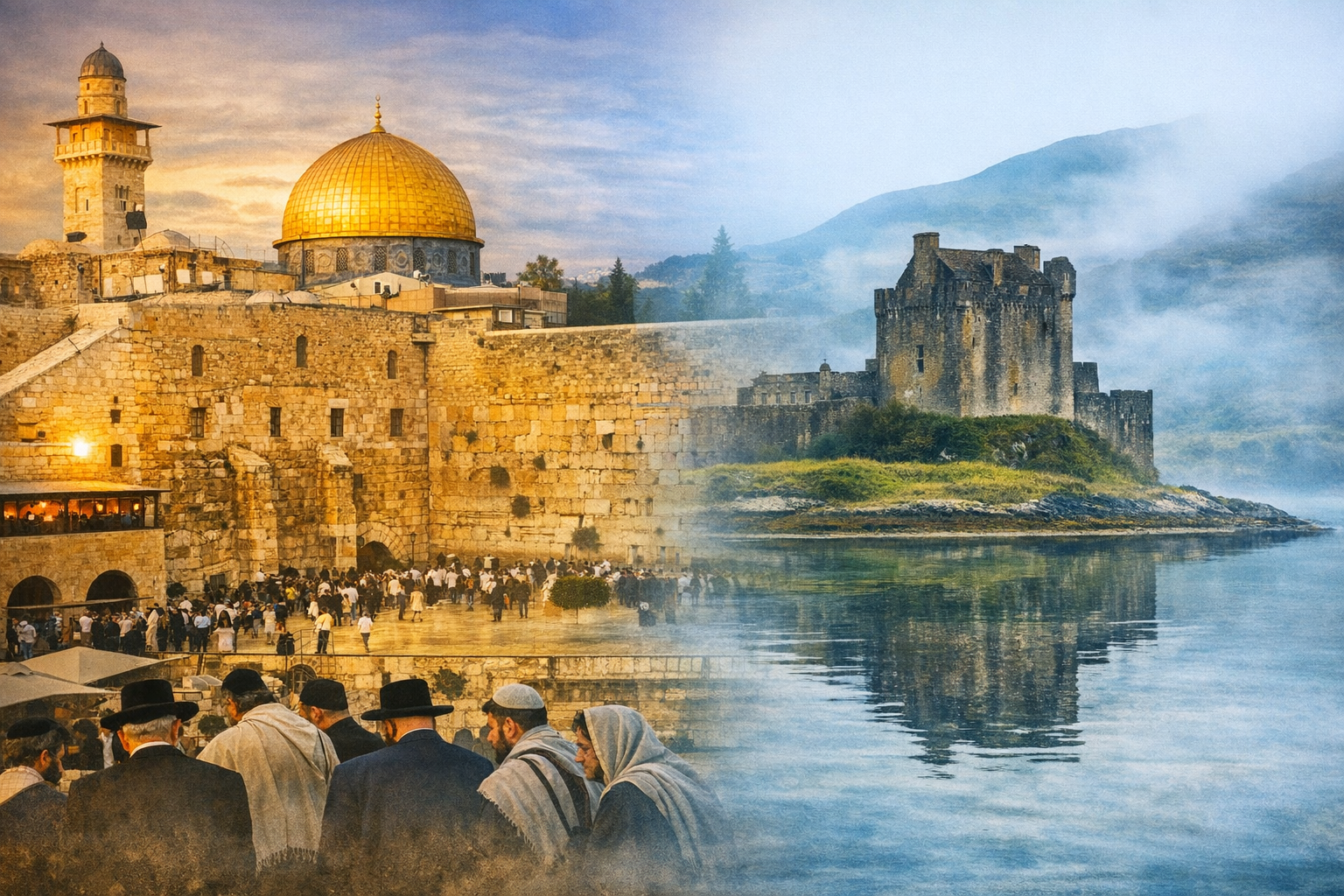
I was today‑years‑old when I finally understood the difference between being Jewish and practicing Judaism. It sent me down a path that connected ancestry, religion, identity, and history in ways I never expected. Right now, with politics and religion so tangled, it’s hard not to feel pulled in two directions. My DNA shows I’m Scottish on one side, Jewish on the other. For a long time, that felt like being caught between two identities, two histories, two worlds.
That moment marked a turning point, reshaping the way I saw myself and the world around me. The truth was older, stranger, and more deeply human than I had ever imagined.
What I learned is that my Jewish ancestry has nothing to do with religion. Judaism is the faith. Jews are the people. And those people existed thousands of years before the religion ever took shape. DNA doesn’t measure belief; it measures ancestry. And that ancestry goes straight back to the ancient Levant, long before anyone had ever heard of Judaism, Christianity, or Islam. The people who eventually became the Israelites were part of the same ancient world as the Canaanites, Phoenicians, Arameans, and early Arab tribes. All of them came from the same deep human layers that formed in the cradle of civilization — the region stretching across ancient Iran, Mesopotamia, Anatolia, and the Levant.
What finally brought clarity was the realization that one can be Jewish without being a Jew in the religious sense. The English language, in its simplicity, uses a single word to describe both ancestry and belief, though they are not the same. When DNA speaks of ‘Jewish,’ it means lineage, not faith. Yet most people hear belief, and in that misunderstanding, confusion takes root.
With that understanding, another truth emerged. The Scots—my other half—are woven from the same ancient story. Not in a literal or theological sense, but in the deep, human sense that predates nations and names. Before Scotland, before Celts, Picts, or Gaels, the ancestors of the Scots were shaped by the same early migrations that flowed from the cradle of civilization. Early farmers and herders, ancient peoples who left the first cities and fields, moved north and west over thousands of years, mingling with Ice Age hunters and the peoples of the Steppe. From that long mingling rose the early Celtic cultures, and from them, the Gaels, the Picts, the Britons, and, in time, the Scots.
In reflecting on all this, I saw that I had spent years believing I belonged to two opposing worlds, when in truth, both sides of my ancestry were distant kin long before either bore a name. The people came first. The faiths followed. Politics arrived much later, a recent chapter in a much older story.
What is hardest to grasp is that the divisions we see today are far younger than the bonds we share. My DNA does not divide me; it reminds me that we all began in the same place, and the boundaries we draw now are recent, set against the long sweep of human history.
Today, years old, and suddenly aware that my ancestry is older than any religion, older than any nation, older than any label we use today. We all came from the same cradle. We just wrote different chapters afterward.
JEWISH BY BLOOD, NOT BY BELIEF — AND WHY THAT MATTERS