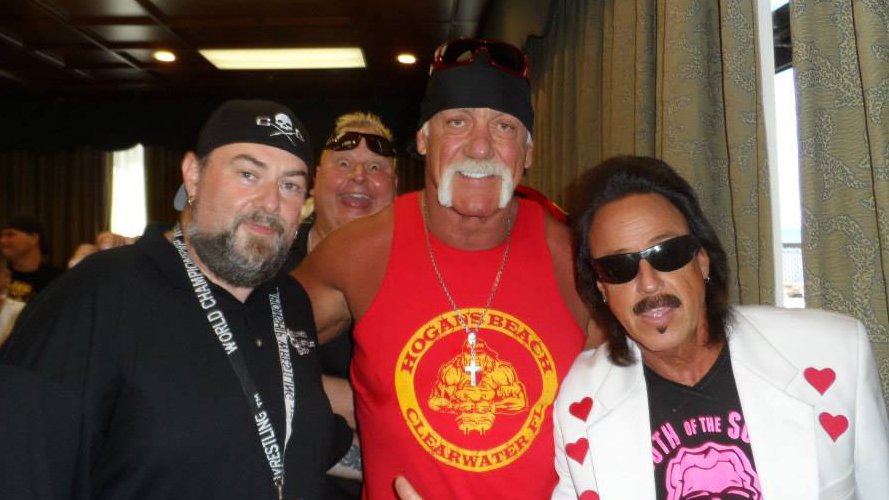
I finally watched the new Hulk Hogan: Real American series on Netflix. It took me a while. Hulk has always been a polarizing figure, even for me, and it’s hard to separate the character from the person. I didn’t think I knew him well, but the times I spent with him were genuine, and my memories reflect that. He was always kind to me. He’d interrupt Jimmy’s calls just to shout “Hi Brother” from the background. He sent signed birthday gifts. He helped me through the XWF mess. He managed how Roddy regarded me and helped him trust me. When Brutus or anyone else was being difficult, Hulk handled it quietly. He valued that I kept things private and didn’t make myself the story, unlike many photographers and journalists. Nothing was ever too much trouble to ask him for. Whenever he met my son, he was more than gracious.
One thing the documentary didn’t fully capture — but I lived — was how the true greats never resented Hulk’s presence. Sting. Rick Rude. Mr. Perfect. Lex Luger. They were all acknowledged stars, and they understood exactly what Hulk brought with him. They didn’t shrink. They didn’t complain. They knew what standing next to him meant for business. And then there was Randy Savage. I saw that dynamic up close. No matter how far apart they drifted, they were Ali and Frazier — destined to orbit each other, destined to collide, destined to define each other. That kind of rivalry is cosmic. You don’t choose it. It chooses you. Ric Flair? Same thing. Two all‑time greats who understood their value — to the business, to the fans, and to each other. They protected themselves, but they also protected the dance. They knew the business needed both of them to survive.
Seeing Dusty Rhodes acknowledged was special. People call him a gift to wrestling for a reason. He saw things others missed. He was one of my biggest mentors, along with Jimmy. He would sit and talk with you as if there was no rush. He was humble and had real vision. I don’t think anyone understood wrestling better than he did. He is deservedly the most cited figure in any wrestling documentary.
The documentary’s ending destroyed me. I knew how the story ended, but seeing him three weeks before… seeing him still Hulk… it was shocking. How does someone that larger‑than‑life fade that fast? And then you get the people taking credit for things they barely touched. The ones who rode the train all the way to retirement. The ones who suddenly want to be historians. Hearing HHH acknowledge Hulk’s importance, then telling people they didn’t have to pay their respects, was galling. Pay your fucking respects. Heavy is the head that wears the crown — and nobody since has worn it with more dignity and less self‑preservation. Wrestling is a brutal business. Very few succeed. Even fewer reach the summit. And almost none stay there. Look at your big contracts, your days off, your luxury houses, your mainstream exposure. You’re not wrestling on some backwater channel at 2 AM anymore. As much as Vince McMahon repulses me, a lot of my friends have better lives because of him. Same with Hulk.
Bret Hart… how bitter can one man be? You had it all. A career people would kill for. A legacy most wrestlers only dream of. And yet every time, it’s the same tired list of villains: Goldberg, Hogan, Warrior, Michaels, Davey Boy… all unfit to lace your boots, all horrible people. We get it. But maybe turn that mirror around. You talk about people being stuck in their gimmick — you’re the dictionary definition. You destroyed your own legacy. Bitter is not a good look, and it’s exhausting.
Kevin Nash, who has more reason than anyone to be bitter, carries himself like a prince. Funny how that works.
WrestleMania 18 — the match with The Rock — that should’ve been the ending. The perfect final chapter. The crowd, the energy, the moment — lightning in a bottle. A career‑defining sendoff that most wrestlers would sell their souls for. But it wasn’t the end, and there was so much more that could’ve been built in a better way. So many more chapters that could’ve been written. The man still had presence, charisma, and the kind of mythic aura you can’t manufacture. He could’ve pivoted, reinvented, evolved — if the right people had been around him, if the right advice had been given, if the noise hadn’t drowned out the human being underneath.
And that’s the part that hits hardest. For someone who was constantly surrounded by people — and they say it frequently in the documentary — how was he so alone? How does a man with an entourage end up isolated? How does the most recognizable face in wrestling history become the loneliest man in the room? That’s the tragedy nobody talks about.
I can’t ignore the party scene, the drugs, or the chaos that came with sudden fame. The steroid era happened. It was a different time, and in many sports, people didn’t think they were doing anything wrong. Living as both Hulk Hogan and Terry Bollea blurred the lines. The public wanted the superhero, not the person. I understand the pressure of having to be the character everyone expects, even when it’s hard to keep up. That’s where the loneliness starts — when the real person gets lost behind the image.
The political side of his public image always felt off to me. I didn’t like where it went, and it didn’t match the person I saw in private. Privately, he voted — and he voted for Trump twice — but he did it quietly, thoughtfully, without the noise or the showmanship people assume. That was the version of him I believed, even if I didn’t know him as well as I would’ve liked. Then Butler happened, and suddenly he was publicly all‑in. That shift never felt like it came from him. Most public figures don’t want to alienate half their fan base. The man I believed in wasn’t driven by outrage or ideology. He was driven by loyalty, by the people around him, and sometimes those people weren’t giving him the best guidance. That gap between who he was in private and how he appeared in public stayed with me more than anything he ever said.
And I’ll be honest — I hated seeing Trump all over the documentary. Not because of politics, but because it dragged me right back to the 90s, when I had the sense and the guidance to avoid working for his companies. Same with Vince. Different men, different worlds, but the same instinct: stay clear. I kept my hands clean from both of them, and watching the documentary reminded me exactly why. It was strange seeing Hulk step into that space publicly when the private version of him never matched it.
Watching the documentary took me back. Hulkamania in the WWF. Then Hulk arrived in WCW — and how disappointing everything was at first. Not his fault. WCW didn’t know how to market what we had. They listened too much to the sheets, the early internet, the smarks. Then the nWo hit, and everything changed. If only I’d slowed down and smelled the roses. Nothing lasts forever.
The last time I saw him was at WrestleReunion 2013 in Clearwater. He wasn’t advertised and didn’t have to be there, but he showed up anyway. He came to see Jimmy, Bobby Heenan, the Nasty Boys, Demolition, Koko, Mean Gene, his friends, and the fans. He sat, talked, and signed whatever people wanted. That was just who he was.
The real People’s Champion.